
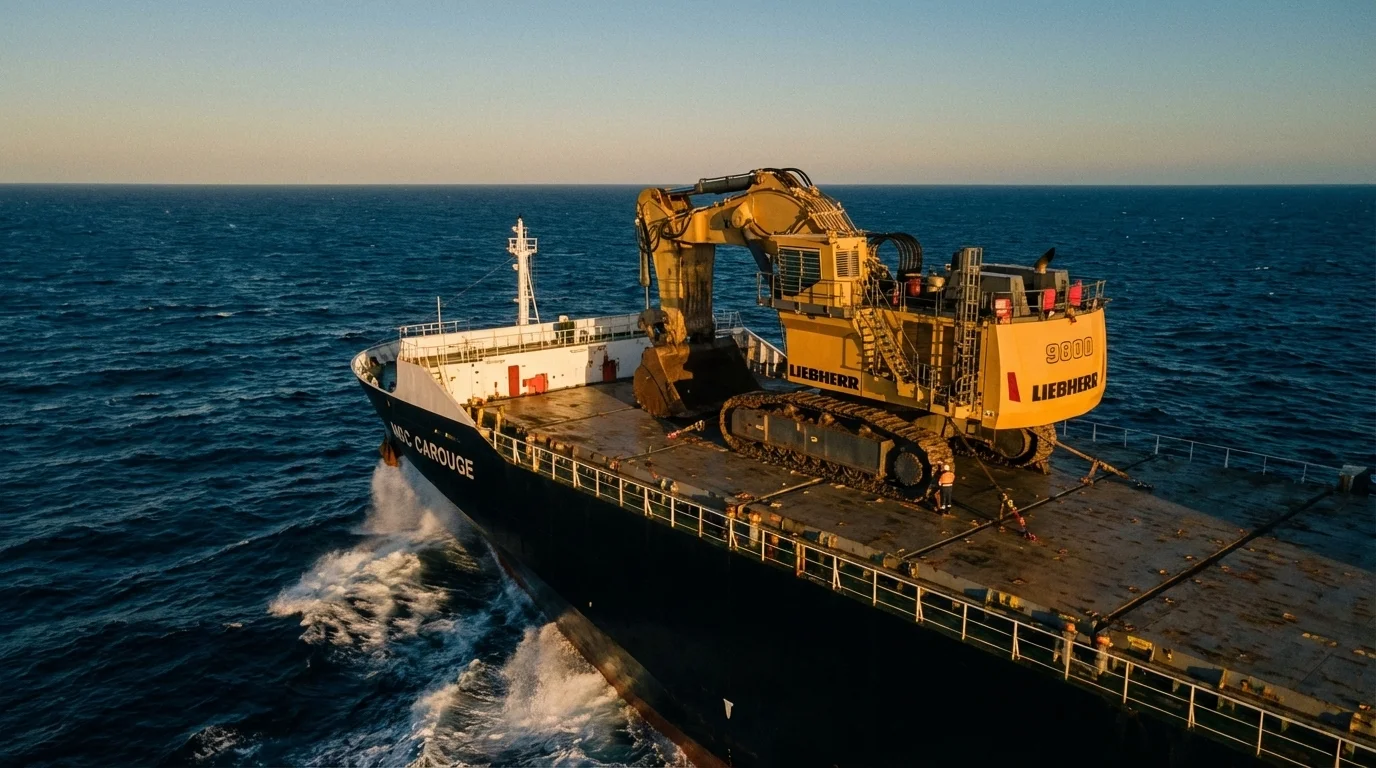
If you look at a logistics map of Africa, you will see a continent divided by a simple mechanical feature: The Steering Wheel.
West Africa (Nigeria, Ghana, Senegal) follows the "Left-Hand Drive" (LHD) standard, driving on the right side of the road like Continental Europe and the USA.
East and Southern Africa (Kenya, Tanzania, South Africa) follows the "Right-Hand Drive" (RHD) standard, driving on the left side like the UK and Japan.
For the passenger car market, this creates a hard trade barrier. A contractor in Nairobi cannot easily import a BMW X5 from Munich because it is legally restricted or prohibited due to the steering configuration.
However, for the Heavy Machinery and Industrial Sector, this barrier is largely an illusion.
A Caterpillar D8 Dozer, a Liebherr Mobile Crane, or a soil compactor has no "lane." The cabin configuration for "Yellow Metal" is standard globally. Even for commercial trucks (Tippers and Prime Movers), the regulations in East Africa often allow for specific exemptions or practical usage that makes German iron highly desirable.
This guide explains why savvy East African contractors are bypassing the traditional UK/Japan routes and sourcing their heavy fleets directly from Germany.
Part 1: The "Yellow Metal" Agnosticism
The first rule of heavy machinery import is simple: Earthmoving equipment is legally agnostic.
When you are buying an Excavator, a Wheel Loader, a Grader, or a Paver, the steering position is irrelevant. These machines operate on construction sites, mines, and quarries—not highways.
Global Standardization: A Komatsu PC210 manufactured for Germany is functionally identical to one manufactured for the UK. The controls are standard.
The Price/Quality Arbitrage: Because many East African buyers assume they can't buy from Germany, the competition for German machinery is often lower than for Japanese units. This allows informed buyers to secure higher-spec machines at better prices.
Part 2: The "Euro 3" Sweet Spot (Technical Deep Dive)
This is the most critical technical detail for any African importer. The biggest challenge for running modern European trucks in Africa is Fuel Quality.
Modern trucks in Europe (Euro 6 standard, post-2015) are built with incredibly sensitive emissions systems. They require AdBlue and Ultra-Low Sulfur Diesel (ULSD). If you run a Euro 6 Mercedes Actros on high-sulfur diesel found in many parts of Africa, the DPF (Diesel Particulate Filter) clogs, the sensors fail, and the truck enters "Limp Mode."
The German Opportunity:
Germany is currently undergoing a massive fleet renewal. Companies are selling off their "older" generations of trucks—specifically Euro 3, Euro 4, and Euro 5 models (produced roughly 2005-2014).
These trucks are the "Goldilocks" zone for African operations:
- Robust Engineering: Models like the Mercedes-Benz Actros MP2/MP3 or the MAN TGA/TGS feature mechanical injection systems or simpler electronics that are far more tolerant of varying fuel quality.
- No AdBlue Required: Many of these older units can operate without the complex AdBlue infrastructure.
- Condition: Unlike a 15-year-old truck from other markets that might be thrashed, a German truck from this era likely has a full service history (Scheckheft) and was maintained to pass the strict annual TÜV inspection until the day it was sold.
We specialize in sourcing exactly these "Africa-Ready" specifications.
Part 3: LHD Trucks in an RHD World?
But what about Tippers and Mixers? Can you really use a Left-Hand Drive German truck in Tanzania?
The "Off-Road" Loophole:
For many large-scale infrastructure projects (dams, highways, mines), the equipment never leaves the site. In a closed quarry environment, steering side is a matter of operator preference. In fact, many operators prefer LHD trucks in quarries because it allows them to see the edge of the pit or the dump zone better depending on the traffic flow of the site.
The Transit Corridor:
While strict RHD laws apply to city driving in Nairobi, there is a thriving trade in LHD trucks for Cross-Border Logistics. Trucks transiting from Dar es Salaam to DRC, Rwanda, or Burundi (which are LHD countries) often originate from LHD stock. Germany is the prime source for these long-haul tractor heads.
Part 4: Quality vs. The "Grey Import"
Why not just buy from Japan or China?
1. The "Tropical Spec" Myth:
Many "Tropical Spec" machines sent to Africa are actually de-contented, lower-quality versions of the main model.
2. The German Steel:
German-spec machines are built for the heavy Central European construction industry. They often feature:
- Heavy Duty Chassis: Reinforced frames to handle max loads.
- Winter Packages: High-capacity batteries and starters (which paradoxically work great in heat because they have robust cooling systems).
- Hydraulic Lines: Auxiliary piping for hammers and shears is often standard on German excavators, whereas it is an expensive option elsewhere.
Part 5: Solving the Logistics (Mombasa & Dar es Salaam)
Shipping heavy machinery from Hamburg to East Africa requires a specific logistical approach. Unlike shipping to Lagos, the transit time is longer (via Suez Canal), and the routes are specialized.
1. RoRo (Roll-on/Roll-off):
We utilize specialized RoRo lines (like Höegh or Wallenius Wilhelmsen) that service the East African coast. This is the cheapest method for drivable trucks and cranes.
2. The "Static" Solution:
For tracked excavators or non-runners, we don't just put them on a flat rack (which is expensive). We often use Mafi Trailers on RoRo vessels. This provides a safe, under-deck transport solution that protects the machine from saltwater spray during the voyage.
3. Dismantling Strategy:
For buyers in landlocked Uganda or Rwanda, shipping a massive machine whole is costly due to road transport permits from the port.
Our Strategy: We can professionally dismantle a 20-ton excavator in Germany, load it into a standard 40ft container, and ship it to Mombasa.
- Benefit: Ocean freight is cheaper.
- Benefit: Road transport to Kampala is standard container trucking (no low-loader required).
- Benefit: Zero theft of parts during transit.
Conclusion: Expanding Your Sourcing Horizon
If you are a contractor in East Africa, limiting yourself to RHD markets means you are missing out on the largest, highest-quality inventory of heavy machinery in the world.
German machinery is built to last, maintained to perfection, and—with the right sourcing partner—entirely accessible to your market. Don't let the steering wheel dictate your fleet quality. Focus on the iron.
Ready to upgrade your fleet?