
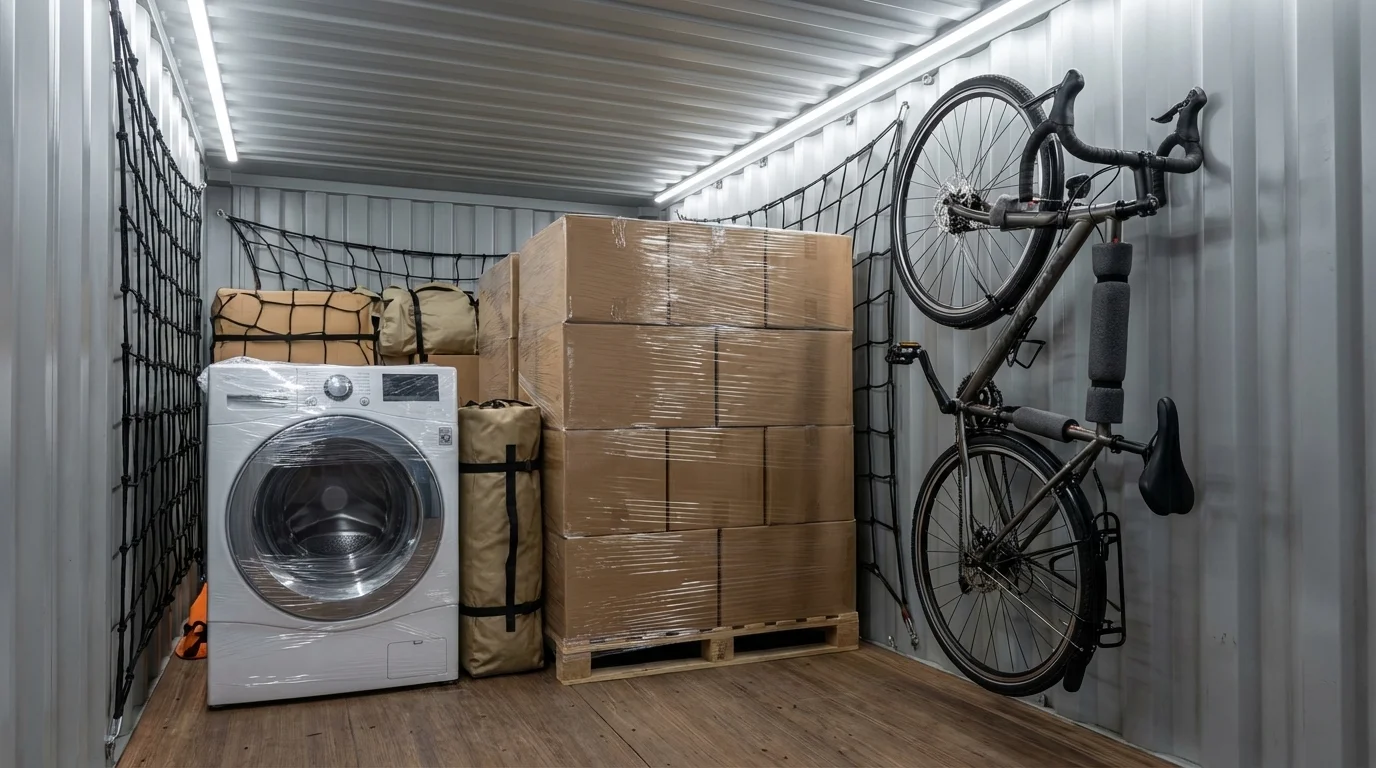
In the world of international logistics, the most expensive commodity you can ship is Air.
If you book a 40ft High-Cube container to ship personal effects, a car, or shop inventory from Germany to Ghana, you are paying a flat market rate for that steel box. Whether that box is packed tight to the roof or is only 60% full, the shipping line charges you the exact same amount.
Let's look at the math. If a container to Tema or Lagos costs you EUR 3,500 and you leave 15 cubic meters (CBM) of empty space inside, your "Effective Shipping Cost" per unit skyrockets. You are essentially throwing money into the ocean.
But for the savvy importer, this "dead space" represents a massive financial opportunity.
This is the core philosophy behind the Mixed Container Load (Groupage). By filling the inevitable voids with high-density, high-value German goods, you effectively subsidize your shipping costs. In many cases, the profit from the "filler" goods can pay for the entire ocean freight bill.
This guide breaks down the economics of the "Business in a Box."
Part 1: The Physics of Profit (Weight vs. Volume)
Shipping containers have two hard limits: Volume (CBM) and Weight (Payload).
- Volume: A 40ft HC holds roughly 76 CBM.
- Weight: It can carry roughly 26,000 kg.
The Importer's Advantage:
Most personal shipments and general merchandise max out on Volume long before they hit the Weight limit.
Sofas, mattresses, cars, and assembled furniture are "bulky but light." They eat up space but leave tons of payload capacity on the table.
This creates an arbitrage opportunity. You have "Free Weight" available.
- The Void: The space inside a car, the space above boxes, the gaps between furniture legs, the top 30cm near the roof.
- The Filler: This is where you should pack dense, high-value items.
Part 2: The "Tetris" Strategy (What to Source)
You don't just need "stuff" to fill the space; you need items that fit geometrically and sell quickly. At MTN Logistics, we help clients source specific German goods that act as perfect "void fillers."
1. The "Gap" Fillers: Microwaves & Kettles
Used German microwaves (B-Ware) are the ultimate filler.
- Why: They are small, boxy, stackable, and durable.
- Placement: They fit perfectly into the odd gaps between larger pallets or on top of washing machines.
- Market: Every household needs one. They turn over fast in markets like Alaba or Makola.
2. The "Wall" Fillers: Bicycles
High-quality German "Trekking" bikes (brands like Cube, Stevens, Kalkhoff) are in high demand.
Packing Hack: By removing the front wheel and turning the handlebars parallel to the frame, a bike becomes almost flat.
Placement: They can be slid flat against the container walls before the main boxes are loaded, or hung from the ceiling lashings. You can fit 50+ bikes in a "full" container without displacing other cargo.
3. The "Inside" Fillers: Car Interiors
If you are shipping a vehicle, shipping it empty is a sin.
The Rule: The trunk, back seat, and passenger footwells are premium real estate.
- Used Premium Tires: A set of 4 Michelin or Continental tires with 5mm+ tread remaining costs very little in Germany but sells for "liquid cash" prices in Africa.
- Spare Parts: Brake pads, filters, and shocks for the specific car model.
Part 3: The ROI Calculation (Real World Example)
Does it actually make sense to buy extra stuff just to fill space? Let's run the numbers for a typical client shipment to Accra.
The Baseline:
- Client shipping 1 Car + Personal Household Goods.
- Space Used: 70%.
- Space Wasted: 30% (~20 CBM).
- Shipping Cost: EUR 3,500 (100% cost for 70% utility).
The Smart Container Approach:
We help the client source 20 Used Washing Machines (Bosch/Siemens) and 10 Used Flat Screen TVs to fill the gap.
Sourcing Cost:
- 20x Washers @ EUR 100 = EUR 2,000
- 10x TVs @ EUR 80 = EUR 800
- Total Investment: EUR 2,800
- Shipping Cost: EUR 0 (The space was already paid for).
Resale Value in Accra:
- Washers sell for EUR 220 = EUR 4,400
- TVs sell for EUR 180 = EUR 1,800
- Total Revenue: EUR 6,200
Net Profit: EUR 6,200 (Revenue) - EUR 2,800 (Cost) = +EUR 3,400 Profit.
The Result: The profit from the "Filler Goods" (EUR 3,400) has effectively paid for 97% of the entire container shipping cost. The client got their car and household goods shipped almost for free.
Part 4: Sourcing the "Unsourceable"
The math works, but the logistics are hard. How do you find 20 washing machines in Germany in one week? You can't drive around to garage sales.
This is the value of MTN Logistics.
We connect you with Wholesale Aggregators. These are specialized warehouses in Germany that collect, test, clean, and palletize used electronics specifically for export.
Grading Transparency: We ensure you know what you are buying.
- Grade A: Tested, cleaned, retail-ready.
- Grade B: Tested working, visible cosmetic dents (perfect for discount buyers).
- Raw Returns: Untested stock (high risk, high reward).
We handle the pickup, the consolidation at our warehouse, and the professional packing to ensure the heavy washing machines don't crush your personal items.
Conclusion: From Importer to Entrepreneur
Many of the largest import empires in West Africa started with a single mixed container. They realized that logistics shouldn't be a cost center; it should be a profit center.
The German market provides the high-quality supply. The African market provides the insatiable demand. The only missing link is the empty space in your container.
Don't ship air. Ship value.